Torsion vs. Extension Springs in San Jose: Choose Torsion Unless You Have a Narrow Legacy Opening That Can’t Fit the Hardware
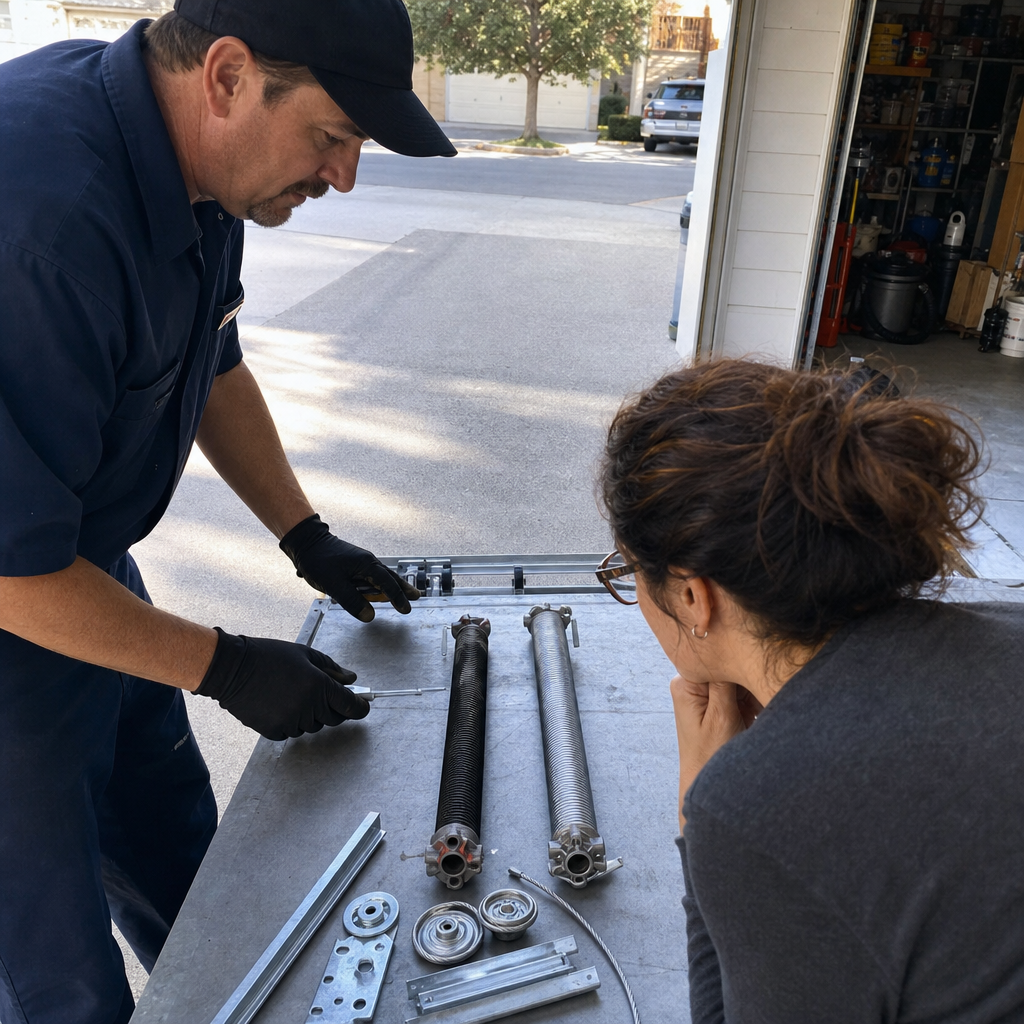
For most San Jose homeowners, torsion springs are the right call — they last longer, operate more smoothly, and critically, they don’t launch across a garage if a coil snaps. Extension springs remain the only practical option when headroom above the door opening is too tight to mount a torsion tube, a situation that shows up mainly in the 1960s–70s single-car framing common along the Berryessa corridor and parts of Alum Rock. If you’re not sure which you have or whether a conversion makes sense for your door, call (833) 991-7288 — Anthony will give you a straight answer.
Why This Choice Matters More Near the Hayward and Calaveras Faults
Every torsion-vs-extension article online eventually gets around to “torsion springs last longer.” That’s true. But it’s the wrong first sentence for a San Jose homeowner.
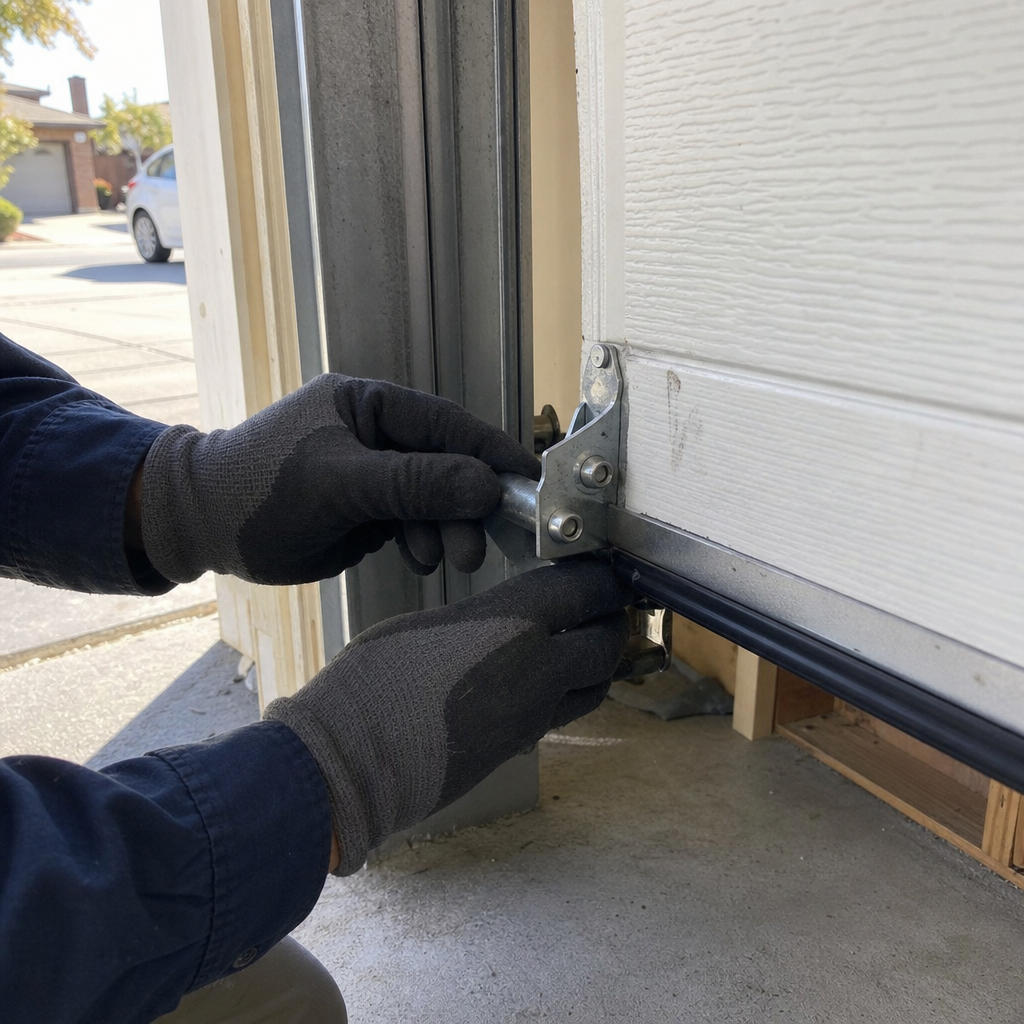
Both the Hayward and Calaveras faults run through the metro area. Extension springs store their energy along the full length of the spring — stretched out on both sides of the door, running parallel to the horizontal tracks. When a coil fractures or the anchor hardware loosens, that stored energy releases instantly. On a quiet Tuesday morning in Cambrian or Alum Rock, a snapped extension spring is startling. During ground movement, the same failure becomes a genuine projectile event. Anthony Perez has pulled snapped extension springs out of garage walls. The hardware leaves marks.
Torsion springs fail differently. They’re mounted on a single steel tube directly above the door opening, and when a torsion spring breaks, it unwinds in place. The failure is loud, but the spring stays on the shaft. That containment difference isn’t a minor technical footnote — near two active fault lines, it’s a safety-priority question that most generic spring guides never raise.
A quick note on safety: both torsion and extension springs operate under extreme mechanical tension. A torsion spring wound to the wrong specification, or an extension spring with a worn safety cable, can cause serious injury. This is not a DIY repair. Anthony specs and installs every spring himself on every job — when the owner is the technician, there’s no diffusion of responsibility on a task with real consequences.
The East Side Legacy Problem: Why So Many Berryessa and Alum Rock Doors Still Have Extension Springs
San Jose’s postwar suburban build-out wasn’t engineered for the spring hardware we’d prefer to install today. The single-car openings framed in the 1960s subdivisions along the Story Road and Berryessa corridors were designed around the lighter extension-spring systems that were standard at the time. Some of those openings have as little as seven inches of headroom clearance above the door — not enough room to properly mount a torsion bar and its end bearing plates.
Converting one of those doors to torsion isn’t impossible, but it requires a structural check first: measuring actual headroom, verifying header clearance, and sometimes modifying the track configuration. Genie and Chamberlain both make low-clearance torsion conversion kits that reduce the headroom requirement, and Anthony has used both on east-side conversions. But a conversion still has to be spec’d to the actual door — its panel count, weight, and width — not eyeballed.
What this means practically: if you live in a home built before 1985 and your garage fits one car with barely any room to spare above the door, you may still be on extension springs not because someone made a bad decision, but because that’s what the framing allowed. The question now is whether a conversion is feasible and worth the cost, or whether well-maintained extension springs with intact safety cables are the more honest recommendation for your specific opening.
A garage door doesn’t lie — it shows you exactly what’s been ignored. When Anthony walks into a Berryessa garage with original hardware, the springs, cables, and anchor brackets tell the whole story before he asks a single question.
Torsion Springs on Larger Doors: Evergreen, Silver Creek, and the Thermal-Fatigue Factor
Move across town to Evergreen or Silver Creek, and the service conversation shifts almost entirely. The 1990s–2000s construction wave in those neighborhoods produced large homes with two- and three-car garage configurations, heavier Clopay and Amarr door panels, and LiftMaster or Chamberlain openers that are now due for upgrades. Torsion springs are the only practical choice at those widths and weights — but sizing them correctly is where the work actually is.
San Jose’s marine layer cycles cool, moist Bay air into the Santa Clara Valley each morning before it burns off by midday. That daily thermal contraction and expansion doesn’t fatigue a properly sized torsion spring in a dramatic way — it just shortens cycle life if the spring was under-spec’d for the door’s actual weight. On a 16-foot, 400-pound insulated Clopay panel, getting the IPPT (inch-pounds per turn) wrong by even a modest margin accelerates wear noticeably over three to five years. Anthony’s 14 years of multi-brand experience — across LiftMaster, Chamberlain, Genie, Clopay, Amarr, Wayne Dalton, Craftsman, and Raynor — means he measures and calculates rather than estimates. He’s worked on enough Evergreen three-car doors to recognize when a spring was installed with the wrong wind count from day one.
If you’re replacing Garage Door Parts in San Jose on a larger door, the spring spec conversation is inseparable from the hardware conversation — the two are sized together.
Side-by-Side: Torsion vs. Extension Springs for San Jose Doors
| Factor | Torsion Springs | Extension Springs |
|---|---|---|
| Failure mode | Unwinds in place on shaft — contained | Can release laterally — projectile risk |
| Seismic safety near Hayward/Calaveras faults | Significantly safer failure containment | Higher risk if anchor hardware loosens |
| Typical lifespan (San Jose climate) | 10,000–20,000 cycles depending on gauge | 7,000–10,000 cycles on legacy hardware |
| Headroom requirement | Minimum ~10–12 inches standard; low-clearance kits available | Works in tight 7-inch headroom openings |
| Best fit in San Jose | Evergreen, Silver Creek, most post-1985 homes | Legacy narrow openings in Berryessa, Alum Rock |
| Repair cost range (San Jose market) | $210–$400 | $210–$400 |
Repair pricing runs the same range for both spring types — $210–$400 in the current San Jose market — so the choice between them isn’t a cost question. It’s a safety, fit, and longevity question. Call (833) 991-7288 for a free estimate on your specific door.
How Anthony Sizes and Replaces a Spring: What the Job Actually Involves
- Measure the door, not just the spring. Door height, panel count, and actual weight determine the spring specification. A door that’s had extra insulation added since original installation may weigh significantly more than its factory spec suggests.
- Identify headroom clearance. On any east-side legacy opening, Anthony measures the actual space above the door before any conversion discussion begins. Low-clearance torsion conversion kits from Genie and Chamberlain are available, but they’re not a one-size solution.
- Calculate IPPT for torsion installations. Inch-pounds per turn is set by the drum size, cable length, and door weight together — not by the spring alone. This is where an incorrect guess causes premature wear or dangerous over-tension.
- Inspect safety cables on any remaining extension-spring installation. If extension springs are staying, the safety cables running through their center must be intact and properly anchored. A safety cable doesn’t prevent a spring from breaking, but it does prevent the broken spring from traveling across the garage.
- Test balance and opener load after installation. A properly balanced door should hold position at mid-travel with the opener disconnected. Anthony tests this on every job before the invoice is written.
Common Local Scenarios Anthony Sees
- Berryessa single-car with original 1970s extension springs: Usually still functional but overdue for safety cable inspection. Conversion to torsion is often feasible with a low-clearance kit but needs a headroom measurement first.
- Alum Rock two-car with one broken spring: The working spring is typically the same age as the broken one — replacing both at the same time is the practical call, not an upsell.
- Evergreen three-car with a five-year-old torsion spring that’s already noisy: Usually a sign the spring was under-spec’d for the door’s actual weight when installed. Heavy insulated Clopay panels weigh more than standard panels and need a heavier-gauge spring.
- Post-2019 opener replacement triggering a spring conversation: California’s AB 869 requires battery backup on all new residential openers sold in the state — a compliance point Anthony raises on every opener job. While the opener is being addressed, it’s the right time to assess whether the spring is matched correctly to the door.
FAQs: Torsion vs. Extension Springs in San Jose
Torsion springs are significantly safer near the Hayward and Calaveras faults because they fail in place on the torsion shaft rather than releasing energy laterally. Extension springs store tension along their full length and can become projectiles if a coil fractures or anchor hardware loosens during seismic movement — a risk that’s real and credible in San Jose, not a theoretical edge case. If your east-side home still has original extension springs, ask Anthony about a conversion assessment.
Spring repair in San Jose runs $210–$400 for either spring type, with the final number depending on spring gauge, door weight, and whether both springs need replacement at the same time. Replacing one spring when the other is the same age usually costs less upfront than you’d spend on a second service call six months later. Call (833) 991-7288 for a free estimate on your specific door.
In most cases, yes — but it depends on how much headroom clearance you have above the door opening. Standard torsion hardware needs roughly 10–12 inches; some 1960s–70s Berryessa and Alum Rock framing has less than that. Low-clearance torsion conversion kits from Genie and Chamberlain can solve this in many situations, but the conversion has to be spec’d to your actual door weight and opening dimensions, not assumed. Anthony measures before he recommends.
The most common cause is a spring that was sized for a lighter door than the one actually installed — heavy insulated Clopay or Amarr panels weigh considerably more than standard panels, and an under-spec’d spring cycling under extra load in San Jose’s marine-layer climate will fatigue ahead of schedule. If your torsion spring is making noise on a door that’s only a few years old, that’s almost always the diagnosis rather than a defective spring. Properly sizing the replacement spring to the actual door weight corrects the problem.
Ready to Sort Out Your Springs?
If you’re not certain which spring type you have, whether a conversion makes sense, or why your door is suddenly struggling, Premier Garage Door Service San Jose keeps things simple: Anthony Perez, Owner and Lead Technician with 14 years of hands-on experience and 524 verified reviews behind him, shows up personally and gives you a straight answer. No rotating crews, no callbacks from a dispatcher. Call (833) 991-7288 for a free, no-pressure estimate — we serve San Jose and the surrounding South Bay.
You can also explore our Garage Door Parts page for information on springs, cables, and hardware components, or visit our home page for the full picture of what we do.
Written by Anthony Perez, Owner & Lead Technician at Premier Garage Door Service San Jose, serving San Jose, CA.