Repair or Replace Your Garage Door in San Jose? Measure the Opening First.
Repair wins in most San Jose situations — unless your panels are structurally compromised and your opening is a standard width. Before you commit to either side of this decision, measure your opening. If you’re in one of the older east-side neighborhoods and you’re looking at an 8-foot single or a 15-foot double, the replace calculation just got a lot more expensive than any online guide will show you. For a no-pressure assessment, call (833) 991-7288 — Anthony Perez will look at the actual door, not just take a guess over the phone.

The Hidden Third Variable: Non-Standard Framing in 1960s San Jose Tract Homes
Most repair-or-replace guides treat the decision like a simple math problem — repair cost vs. replacement cost, pick the lower number. That framework works fine if you live in a 1990s Evergreen build with a standard 9-foot single or 16-foot double opening. It quietly breaks down if you live in a postwar ranch home along the Story Road or Berryessa corridor.
In those 1960s subdivisions, garage openings were commonly framed for 8-foot singles or narrow 15-foot doubles — dimensions that don’t appear in modern panel catalogs. That means replacement often requires either a custom-order panel run (adding 2–4 weeks of lead time and a meaningful cost premium) or a structural header modification to bring the opening to a standard width. Neither option shows up on the estimate templates franchise dispatchers hand their techs.
Across 14 years and hundreds of San Jose jobs, Anthony Perez has watched homeowners regret fast replacement decisions on non-standard frames far more often than slow repair decisions on salvageable panels. A garage door doesn’t lie — it shows you exactly what’s been ignored. When the frame is the actual problem, you’d be dropping new door money into the same structural constraint that caused the headaches to begin with.
If your opening measures non-standard, a well-executed Garage Door Repair in San Jose — fresh panels, new hardware, reconditioned tracks — frequently delivers another decade of reliable service at a fraction of what a custom-order replacement would run.
A Decision Framework Built Around San Jose’s Two Housing Generations
San Jose’s garage door stock isn’t uniform, and the repair-or-replace math differs depending on which construction era your home belongs to. Here’s how Anthony approaches the two dominant categories:
40–60-Year-Old Doors in Cambrian, Berryessa, and East San Jose
These doors were built before insulated panels became standard, before modern 24-gauge steel was commonplace, and long before smart-opener compatibility was a consideration. They’re also the doors most likely to sit in non-standard openings. The key questions Anthony asks on these jobs:
- Is the frame square and structurally sound? If yes, repair is almost always worth pursuing first — the frame is the hard part to fix.
- Are the panels dented or cracked beyond cosmetic damage? Surface rust and minor dings are repairable. A panel that’s buckled through its structural layer isn’t.
- Is the opener pre-2019? Any opener replacement in California now triggers AB 869 compliance — the unit must include battery backup. That’s not a sales add-on; it’s state law, shaped directly by Bay Area earthquake and power-outage experience after events like Loma Prieta. Factor that cost into your replace estimate honestly.
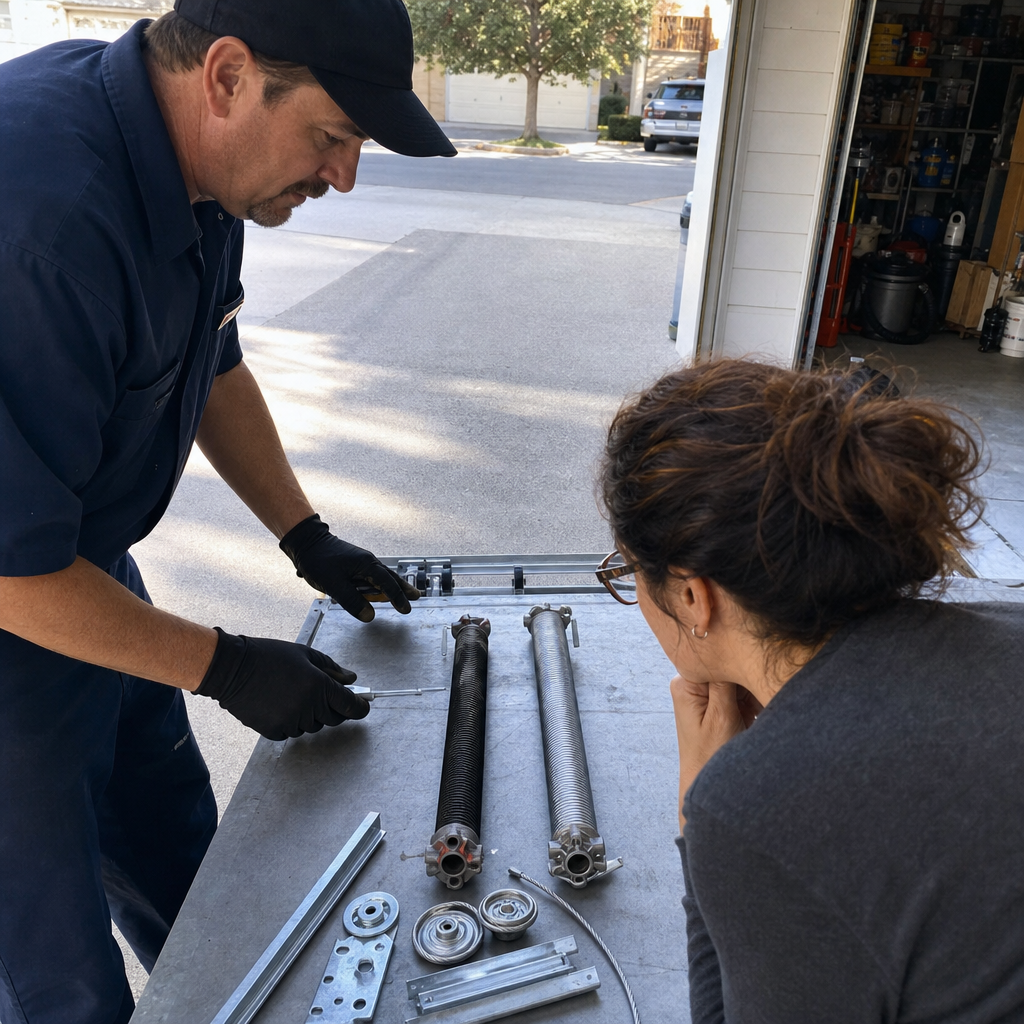
- Are springs and cables the primary failure point? Spring repair in the San Jose market runs $210–$400. Cable repair runs $155–$295. Either is a straightforward fix on an otherwise solid door — not a reason to replace.
1990s–2000s Doors in Evergreen and Silver Creek
The tech-executive homes in Evergreen and Silver Creek tend to have standard-width openings, heavier-gauge hardware, and 3-car configurations that support modern smart-opener systems. These doors are also young enough that replacement panels from brands like Clopay or Amarr are usually available off the shelf. Here, the replace conversation is more legitimate — especially if insulation performance or smart-home integration is the goal. New insulated panels or a full door swap to a Clopay or Amarr system delivers genuine energy and convenience value when the opening cooperates.
Side-by-Side: When Repair Wins vs. When Replacement Makes Sense
| Situation | Likely Best Path | Typical San Jose Cost Range |
|---|---|---|
| Non-standard opening (8-ft single / 15-ft double), functional panels | Repair hardware, springs, opener | $175–$710 depending on components |
| Standard opening, panels buckled or structurally failed | Panel replacement or full door | $295–$590 (panels) / $825–$2,595 (new door) |
| Pre-2019 opener failing, door otherwise sound | Opener replacement (AB 869 battery-backup required) | $295–$650 installed |
| Spring or cable failure only | Repair — straightforward fix | $155–$400 |
| 1990s–2000s door, standard width, owner wants insulation upgrade | Replace with insulated panel system | $825–$2,595 |
Note: High-tension torsion springs and cables operate under significant mechanical load. Diagnosis and replacement should always be handled by a trained technician — attempting spring or cable work without the right tools and experience carries a genuine risk of serious injury.
How to Work Through the Repair-or-Replace Decision: A Step-by-Step
- Measure the opening width. Standard single is 9 feet; standard double is 16 feet. If you’re at 8 or 15 feet, note it before getting any replacement quote — the cost picture changes substantially.
- Identify the failure point. Is it springs, cables, panels, tracks, or the opener? A single failed component rarely justifies replacing the whole system.
- Check panel integrity. Surface rust and cosmetic dings are repairable. Run your hand across the panel face — flex and buckling through the structural layer is the real indicator of replacement need.
- Factor in the AB 869 opener requirement. If the opener is part of the conversation, a battery-backup unit is mandatory under California law regardless of which path you choose. Get that line item in any estimate.
- Compare repair cost against door age and frame condition. A 50-year-old door in a non-standard frame isn’t the same replacement conversation as a 15-year-old door in a standard Evergreen opening. Age tier matters.
- Get an on-site assessment, not a phone quote. The specific variables — frame condition, panel generation, opener compatibility — only reveal themselves in person. Anthony handles these assessments directly; there’s no relay through a call center.
For a full-scope look at what’s involved in addressing specific component failures, visit our main Garage Door Repair page.
San Jose’s Marine Layer and the Components It Wears Down Fastest
One detail that rarely makes it into generic guides: San Jose’s daily marine-layer cycling — cool, moist Bay air pushing into the Santa Clara Valley each morning before burning off — accelerates weatherseal cracking and gradually fatigues torsion springs through repeated thermal contraction and expansion. If your door is stiff on cold mornings and operates fine by noon, that’s not a mystery — that’s the climate doing what it does to 30-year-old steel hardware.
This doesn’t automatically mean replacement. It does mean that if you’re repairing, Anthony will spec components rated for the coastal thermal cycling this area actually delivers — not hardware calibrated for Phoenix or Sacramento. That distinction matters for how long the repair holds.
Frequently Asked Questions
Garage door repair in San Jose typically runs $175–$710 depending on which components need attention — springs ($210–$400), cables ($155–$295), opener repair ($140–$380), or panel replacement ($295–$590). A full new door installation runs $825–$2,595, not counting any structural modifications required for non-standard openings in older east-side homes. Call (833) 991-7288 for a free on-site estimate — phone quotes on this decision are rarely accurate.
Panels that have buckled through their structural layer — not just surface dents or rust streaks — are generally beyond cost-effective repair. If you can flex the panel face significantly by hand, or if a section has separated from its joint, replacement panels make more sense than patching. Cosmetic damage alone, especially on a door with a non-standard opening width, is almost never worth replacing the whole system over.
Yes — under AB 869, any new residential garage door opener sold or installed in California since July 1, 2019, must include a battery backup system. This applies whether you’re replacing a failed unit or upgrading as part of a full door replacement. Given that the Calaveras and Hayward faults both run through the San Jose metro, this isn’t a checkbox item — it’s a safety function that works when grid power doesn’t. Anthony will walk you through what’s required on-site.
Not necessarily, especially in San Jose’s older neighborhoods. A 40-year-old door in a non-standard 8-foot or 15-foot opening can cost significantly more to replace than to repair, once custom panel orders and potential header modifications are factored in. Age alone isn’t the deciding variable — frame condition, opening width, and current panel integrity are. Anthony Perez, Owner and Lead Technician at Premier Garage Door Service San Jose, has assessed hundreds of these older doors across Berryessa, Cambrian, and East San Jose, and the right call depends on what’s actually in front of you.
Ready to Stop Guessing? Let Anthony Take a Look.
If you’ve read this far and you’re still not sure which way the math runs for your specific door, that’s exactly why an on-site assessment exists. Premier Garage Door Service San Jose offers free estimates with no pressure toward either outcome — Anthony will tell you honestly what the door needs. Call (833) 991-7288 and get a real answer from the person who’ll actually do the work.
Written by Anthony Perez, Owner & Lead Technician at Premier Garage Door Service San Jose, serving San Jose, CA.